
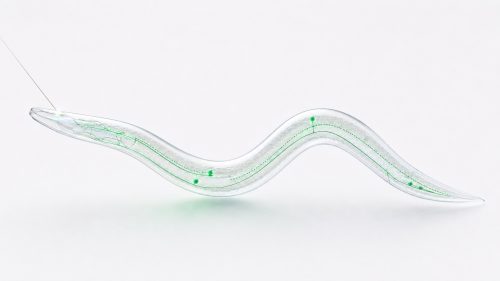
Image 1. Artistic illustration of the gentle touch response in C. elegans. A fine hair-like probe activates touch receptor neurons involved in the animal’s escape reflex.
A research team led by Professor Chaogu ZHENG from the School of Biological Sciences at The University of Hong Kong (HKU), in collaboration with scientists from Princeton University and Columbia University, has discovered how sensory-motor circuits—nerve circuits that turn sensory signals into reflex actions—remain reliable even when some genes or neural connections are disrupted.
Using the gentle touch reflex of the nematode Caenorhabditis elegans (C. elegans) as a model, the team found that this essential survival response is not controlled by a single biological component. Instead, it is supported by several overlapping mechanisms, including existing alternative neural pathways and molecular components that enable neurons to send and receive signals. These layers of genetic redundancy help maintain the touch response and improve the animal’s ability to escape from predators. The findings were recently published in the Proceedings of the National Academy of Sciences (PNAS).
Research Background
Reflex actions are among the most basic and important functions of the nervous system. When an animal senses danger, sensory neurons detect the stimulus and pass the signal through synapses, the contact points where neurons communicate, to downstream neurons that control movement.
The gentle touch circuit of C. elegans is a classic model in neuroscience. Its cellular wiring was mapped at single-cell resolution about 40 years ago, showing how sensory neurons, interneurons, and motor neurons are connected in the reflex pathway. However, the molecular details of how these neurons communicate, and how this communication supports a reliable reflex response, were not fully understood.
To address this question, the team examined synapses in the gentle touch reflex circuit and mapped the molecular mechanisms that allow signals to pass from sensory neurons to downstream neurons.
Key Findings
Through genetic screens and follow-up analyses, the team found that the touch reflex circuit is protected by several layers of genetic redundancy. These mechanisms operate at different levels, including individual genes, synapses, and neural pathways.
In the posterior touch circuit, two gap junction proteins help connect sensory neurons with interneurons. Either protein alone is sufficient to maintain the connection, so losing one of them does not disrupt the touch response.
In the anterior touch circuit, the team found another form of redundancy: two neural pathways can both support the backward movement triggered by touch. Blocking either pathway alone does not stop the motor response, showing that the circuit can continue to function through an alternative existing route.
The team also found that these redundant components are not simply spare parts. Some synaptic genes may not be essential for starting the touch response, but they still affect how strong and effective the response is. For example, removing one gene may not stop the animal from moving backwards after being touched, but it can shorten the reversal distance and make the animal less likely to turn afterwards. This weaker response reduces its ability to escape from carnivorous nematodes.
These findings show that redundancy in the nervous system serves two purposes: it helps prevent an essential reflex from failing, and it strengthens the escape response.
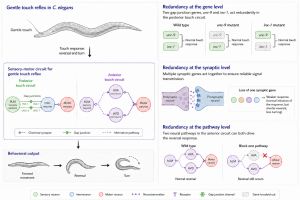
Image 2. Redundant mechanisms supporting the gentle touch reflex in C. elegans.
The diagram shows how genes, synapses and neural pathways work together to maintain a reliable touch response.
Implications
The study provides new insight into how nervous systems protect essential behaviours. It shows that robust neural circuits can be built through overlapping genes, synapses, and neural pathways, so that the loss of one component does not necessarily stop the behaviour.
The corresponding author, Professor Chaogu ZHENG of the HKU School of Biological Sciences, explains, “From an evolutionary perspective, the findings suggest that components which appear redundant in a standard laboratory test may still be preserved because they improve survival in real-life situations, such as escaping from predators. In this way, redundancy is not merely a backup system, but part of how neural circuits produce reliable and effective behaviour.”
For more details, please refer to the journal paper “Synaptic and neural pathway redundancy enables the robustness of a sensory-motor reflex and promotes predation escape in Caenorhabditis elegans” published in the Proceedings of the National Academy of Sciences (PNAS).
香港大學(港大)生物科學學院鄭超固教授領導的研究團隊,聯同普林斯頓大學和哥倫比亞大學的科學家,發現動物大腦在處理「感應與運動」的神經迴路(即接收感官信號並轉化為逃生動作的傳導路線)中,擁有一套極為精密、環環相扣的「後備系統」(Redundancy mechanisms)。這套系統確保了即使部分基因或神經連接因受傷、疾病或突變而受損,動物仍能迅速對危險作出反應,逃離險境。該研究成果已於《美國國家科學院院刊》(Proceedings of the National Academy of Sciences)發表。
微小線蟲的神經網絡「設計圖」
當動物遇上危險時,神經系統必須在短時間內做出反應,將危險訊號極速傳遞給肌肉,指揮身體避開危險。為了揭開大腦如何萬無一失地傳遞這些關鍵訊號,研究團隊以結構簡單、常用作神經科學研究的模型生物「秀麗隱桿線蟲」為研究對象。科學家雖在40年前已掌握這隻微小線蟲的完整神經網絡地圖,但神經元之間在分子層面如何通訊,並在干擾下仍能維持運作,一直是一個未解之謎。港大團隊的發現成功填補了這個科學空白。
神經系統的「多重安全防護網」
研究團隊以秀麗隱桿線蟲的輕觸反射弧(reflex arc)為模型,透過基因篩選及技術分析,發現線蟲的逃生機制並非依賴單一「開關」,而是由包括個別基因、突觸及神經路徑等多個層面共同組成的「多重後備方案」:
蛋白質的「雙保險」鎖:在傳遞輕觸訊號時,神經元之間有兩種不同的「間隙連接蛋白」負責通訊。研究證實,只要其中任何一種蛋白運作正常,訊號就能成功送達。這就像家裡的門鎖設有「指紋」和「密碼」雙重解鎖,壞了其中一個,依然不影響開門。
神經網絡的「自動分流繞道」:若前方道路受阻,手機導航會自動繞道。團隊發現,線蟲體內同時存在兩條獨立的神經通路來控制後退動作。即使人為阻斷其中一條,線蟲仍能透過另一條替代路線順利逃走。
後備零件「性能升級」:最令人驚訝的是,這些後備基因和神經通路並非只在「正選」壞掉時才起作用。它們在日常生活中能優化逃跑的表現——例如讓線蟲退得更遠、轉彎更快,大大提升避開捕食者的機率。
這項發現表明,神經系統中的後備機制具有雙重作用:一方面作為「安全網」防止防禦機制失效,另一方面作為「性能優化器」提升動物的野外生存能力。
打破「冗餘」無用論
該研究為神經系統如何保護關鍵的求生反應提供了新見解。研究表明,穩健的神經迴路可以透過相互重疊的基因、突觸和神經通路構建而成,因此單一組件的缺失並不一定會導致行為失效。
論文通訊作者、港大生物科學學院鄭超固教授解釋道:「從進化的角度來看,這些發現表明,某些在標準實驗室測試中看似冗餘的組件,仍可能因為有助提高生物在真實環境中存活的能力而給保留下來,例如協助動物逃避捕食者等。換言之,冗餘機制不僅是一套後備系統,更是神經迴路產生可靠而有效行為反應的重要一環。」
有關研究的詳細內容,請參閱發表於《美國國家科學院院刊》(Proceedings of the National Academy of Sciences)的論文「Synaptic and neural pathway redundancy enables the robustness of a sensory-motor reflex and promotes predation escape in Caenorhabditis elegans」。