
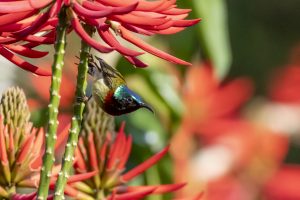
Fork-tailed sunbird © Ivan Lam

Hummingbird © Simon Sin
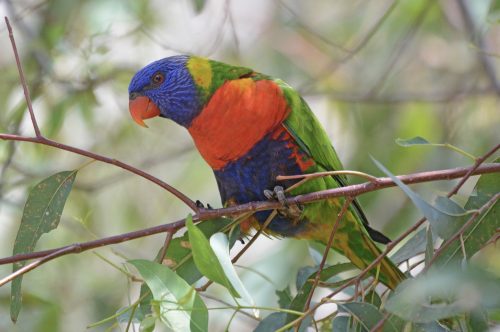
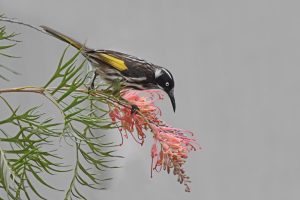
High-sugar diets cause human metabolic diseases, yet several bird lineages convergently adapted to feeding on sugar-rich nectar or fruits. Recent investigation into the molecular mechanisms in hummingbirds, parrots, honeyeaters, and sunbirds involved generating nine new genomes and 90 tissue-specific transcriptomes. Comparative screens revealed an excess of repeated selection in both protein-coding and regulatory sequences in sugar-feeding birds, suggesting reuse of genetic elements. Sequence or expression changes in sugar-feeders affect genes involved in blood pressure regulation and lipid, amino acid, and carbohydrate metabolism, with experiments showing functional changes in honeyeater hexokinase 3. MLXIPL, a key regulator of sugar and lipid homeostasis, showed convergent sequence and regulatory changes across all sugar-feeding clades; experiments revealed enhanced sugar-induced transcriptional activity of hummingbird MLXIPL, highlighting its adaptive role in high-sugar diets.
For more details, please refer to the journal paper “Convergent and lineage-specific genomic changes shape adaptations in sugar-consuming birds” published in Science.
高糖飲食可能引發人類的代謝性疾病,但多個鳥類譜系卻已趨同適應以富含糖分的花蜜或果實為食。研究人員通過生成九個新基因組與九十個組織特異性轉錄組,深入探討了蜂鳥、鹦鹉、吸蜜鳥和太陽鳥的分子適應機制。
比較分析顯示,這些食蜜鳥類的蛋白質編碼序列與調控區域都存在過度的重複選擇信號,提示遺傳元素的重複利用現象。
此外,食蜜鳥類的基因序列或表達變化涉及血壓調控、脂質代謝、氨基酸代謝及碳水化合物代謝相關基因,實驗也證實吸蜜鳥的己糖激酶3具有功能性改變。
MLXIPL作為糖脂代謝穩態的關鍵調控因子,在所有食蜜鳥類譜系中均展現出趨同的序列與調控變化;實驗結果顯示蜂鳥的MLXIPL具有增強的糖誘導轉錄活性,突顯其在高糖飲食適應中的重要作用。
欲了解更多詳情,請參閱發表於《Science》期刊的論文 “Convergent and lineage-specific genomic changes shape adaptations in sugar-consuming birds”