
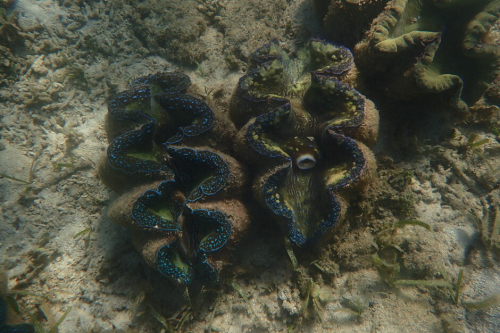
Giant clam (Tridacna gigas) in its natural reef habitat. The colourful tissue contains symbiotic algae that perform photosynthesis and supply energy to the host. Image credit: Isis Guibert.
Giant clams (Tridacna gigas), members of the family Tridacnidae and among the most striking inhabitants of tropical coral reefs, are being driven towards extinction. Over-harvesting for the jewellery and aquarium trade, as well as for food, together with habitat loss and pollution, has severely reduced their populations. Climate change is now compounding these threats, making the situation even more precarious for these vulnerable animals.
There are many species of giant clams in the wild. Some are disappearing faster than others, but the reasons for these differences are not yet fully understood. Other species appear plentiful, yet it remains unclear how far into potential decline they may actually be, and such species may therefore be inadequately protected.
A research team from the Swire Institute of Marine Science (SWIMS) and the School of Biological Sciences of The University of Hong Kong (HKU) has helped address this question by developing an innovative mathematical model that allows conservationists to easily assess feeding strategies of different giant clam species. This knowledge can help conservationists to predict the future vulnerability of different giant clam species and identify those in need of timely protection.
Understanding feeding strategies in giant clams
Giant clams have two feeding methods. As animals, they eat organic matter by filtering it from the surrounding water. At the same time, they also rely on photosynthesis, much like plants do: symbiotic “partner” algae living inside the clam harvest sunlight and share the resulting energy with their hosts.
To determine how much each species relies on these two energy sources, SWIMS researchers used chemical analysis to identify the unique nutritional pathways of six giant clam species. By measuring natural variations in carbon and nitrogen isotopes in both the clams and their symbiotic algae, and integrating these data into a mathematical model they developed — HERS (Host Evaluation: Reliance on Symbionts) — the team quantified how strongly each species depends on photosynthesis versus filter-feeding.
Comparing these values across species showed that giant clams occupy different positions along a nutritional spectrum, with each species adopting a distinct feeding strategy. The fastest-growing and largest clams were found to rely more heavily on their symbiotic algae partners for energy. While this method may support rapid growth, it may also increase vulnerability. A strong dependence on light-harvesting symbionts could increase vulnerability to climate change, as these algae are sensitive to rising sea temperatures. Moreover, larger body size may further heighten exposure to over-harvesting, as such clams are more easily targeted.
These findings suggest that differences in feeding strategy may be vital for assessing extinction risk, offering conservationists a new framework for prioritising protection efforts.
“Giant clams are not just iconic reef residents, they are ecosystem engineers who play a crucial role in the health and resilience of coral reefs,” said Dr Isis GUIBERT, Postdoctoral Researcher at SWIMS and lead author of the study. “Understanding how these nutritional strategies differ among species is key to anticipating their future under environmental change.”
“Our findings highlight that the very traits which make these clams so impressive also put them at greater risk,” explained Professor David BAKER, Interim Director of SWIMS and corresponding author of the study. “By revealing these hidden vulnerabilities, we can better focus conservation efforts where they are needed most.”
“Our approach also sets the stage for future research on other symbiotic reef species, such as corals,” Professor Baker added. “It’s a step forward in understanding and protecting marine biodiversity.”
This work, led by Professor David Baker and Dr Isis Guibert, was carried out in collaboration with researchers including Dr Cecilia Conaco and Dr Patrick Cabaitan from the University of the Philippines, Diliman, as well as Dr Ronnie Estrella, Director of the Semirara Marine Hatchery and Laboratory.
The study was supported by Division of Ecology and Biodiversity PDF Research Award, the Research Grants Council Collaborative Research Fund (17108620), the Environment and Conservation Fund (ECF-67/2016 and CRF7G_C7013-19G), and the Department of Science and Technology of the Philippine Council for Agriculture, Aquatic and Natural Resources Research and Development (DOST-PCAARRD; QMSR-MRRD-MEC-295-1449, 314-1542 and 314-1545).
For more details, please refer to the journal paper “Trophic niche partitioning in giant clams” published in Communications Biology.
香港大學太古海洋科學研究所與生物科學學院團隊,以穩定同位素分析結合自主研發的數學模型HERS,量化六種巨蚌對共生藻光合作用與濾食兩種能量來源的依賴,發現生長最快、體型最大的物種更倚重共生藻,因而在海水升溫下更為脆弱,為保育界鎖定優先保護物種提供新工具。
這類屬於硨磲蛤科(Tridacnidae)的熱帶大型雙殼類軟體動物,廣泛棲息於印太地區的珊瑚礁海域。長久以來,巨蚌因被大量採集作珠寶原料,並用於水族館貿易及食用,加上棲息地遭破壞與海洋污染,族群數量持續下滑。隨着全球暖化加劇,滅絕風險進一步上升。
依賴體內共生藻類進行光合作用
據了解,巨蚌具有雙重攝食機制:一方面透過濾食,從海水中攝取有機顆粒;另一方面則依賴體內共生藻類進行光合作用。共生藻利用陽光製造養分,並將部分能量轉移給巨蚌,使其同時具備兩種能量來源。研究人員透過化學分析,辨識六種巨蚌的營養途徑,量度其與共生藻類體內碳與氮穩定同位素的自然變異,並結合數學模型HERS(Host Evaluation: Reliance on Symbionts,宿主對共生體依賴度評估),量化不同物種對光合作用與濾食攝食的相對依賴比例。
結果顯示,生長速度最快、體型最大的巨蚌物種更依賴共生藻類提供的光合作用能量。此策略有助其快速生長,但共生藻對海水升溫高度敏感,令相關物種在氣候變化下承受更高風險,而且體型較大的物種更易成為過度採捕的目標。
港大太古海洋科學研究所博士後研究員Isis GUIBERT表示, 巨蚌不僅是珊瑚礁的代表性物種,更是維持珊瑚礁健康與韌性的關鍵,了解不同物種在營養策略上的差異,有助於預測其在環境變化下的未來走向。是次研究為海洋保育工作提供嶄新的評估工具,有助更精準識別最迫切需要保護的物種,為制定有效的保育政策奠定基礎。
詳情,請參閱發表於《Communications Biology》的期刊論文: Trophic niche partitioning in giant clams